Why Couples Fight About the Same Things Over and Over (And How to Break the Pattern)

The cycle of relationship rupture and repair is inevitable even in our most loving relationships, simply by nature of us being human. And yet, the health of our lasting connections depends highly on how skillfully we can navigate the necessary emotional repairs. Many couples find a couples therapist to help navigate relationship conflicts. But regardless of whether we seek outside support, we can learn the common underlying themes of recurring fights to better understand why arguing feels so unproductive, and start to connect from a place of deeper understanding.
Identifying Unsolvable Vs. Solvable Problems
A useful strategy for unpacking unresolved arguments is to determine which category of problem they fall into: solvable or unsolvable.
According to the Gottman Institute, a marriage research and therapy organization founded by psychologists John and Julie Gottman, unsolvable relationship problems (which comprise 69% of couple disagreements) are issues guaranteed to reoccur because they stem from underlying differences in core values, personality traits, or lifestyle priorities. Some examples include having a partner who thrives on socializing while you are more introverted, diverging financial values, imbalanced sex drives, or disparate upbringings leading to conflicting parenting frameworks.
On the other hand, solvable problems are those that can be resolved through mindful discussion and compromise. These situational disagreements can also be rehashed over time, but become much more manageable when both partners commit to to self-soothing, open communication, and follow through.
However, instead of finding “fixes” or tidy solutions for problems that are technically unsolvable, navigating those core differences requires leading with empathy and patience. Conversations must emphasize process over content, prioritizing how you talk with each other over any actual decisions you make. Remarkably, when we become skillful in navigating unsolvable problems with grace and vulnerable presence, we come to feel closer and more connected through mutual respect and emotional safety.
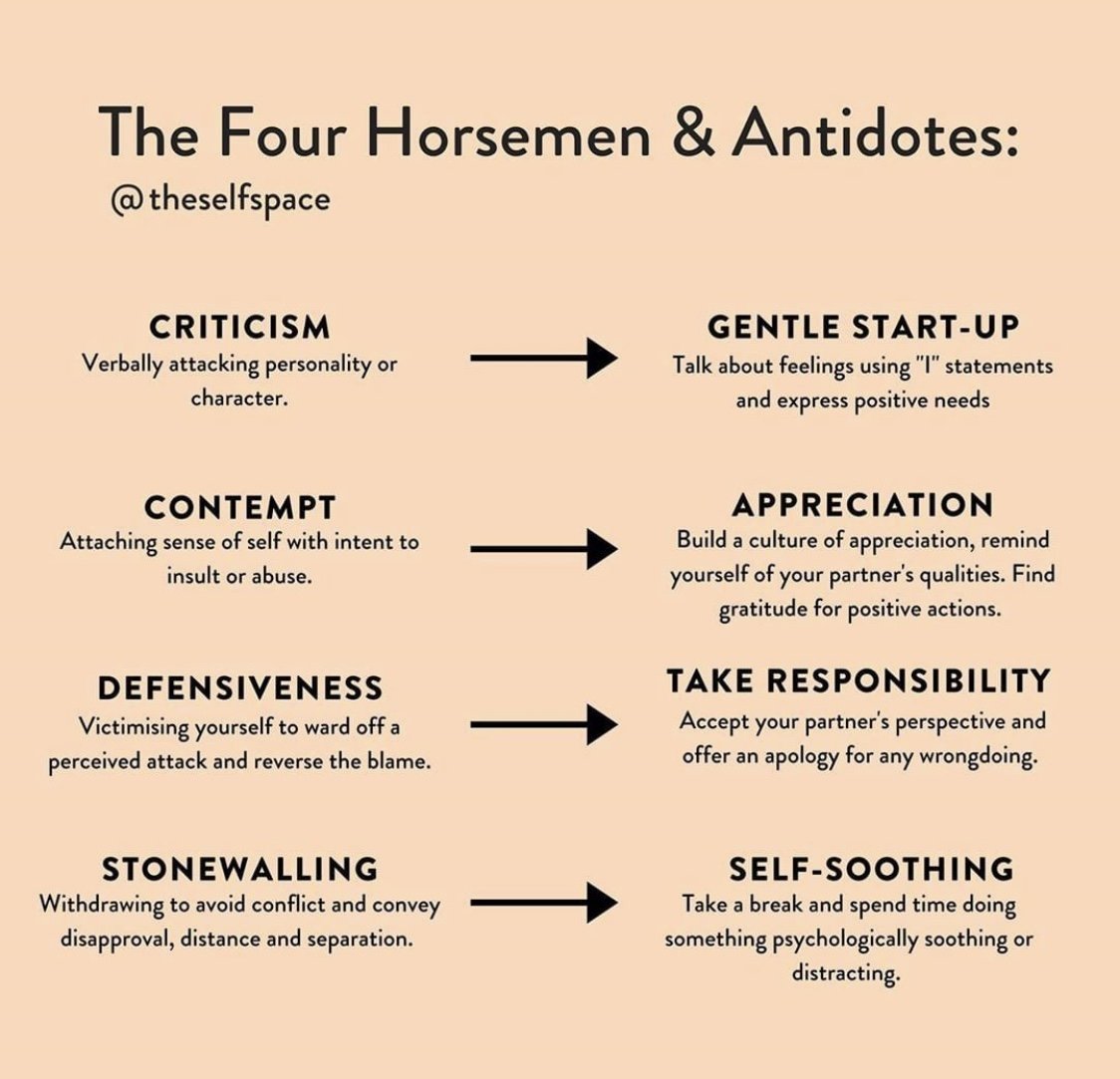
One Gottman’s strategy for navigating these conversations is to commit to the opposite of the “Four Horsemen” behaviors of relationship destruction: using a soft conversation startup, demonstrating consistent appreciation and understanding, taking responsibility for your own side, and practicing self-soothing as needed throughout.
Healing Old Attachment Wounds
A second underlying cause for recurring fights is the resurfacing of attachment wounds. Oftentimes, when our conflicts routinely become escalated or even derailed, it is due to the conscious or unconscious impact of our attachment programming. In the attachment-based therapy Emotionally Focused Therapy (EFT), couples are encouraged early on to identify how they are embodying the roles of pursuer and avoider in their conflict cycles. Since we all have attachment wounds to different degrees, we can unknowingly slide into these roles. Yet we feel the push and pull of desperate abandonment fear and craving for connection that is in conflict with the other’s urge to self-protect and emotionally withdraw.
Finding yourself entrenched in one of these survival positions is a sign that attachment wounds have been activated. While the ruptures our nervous systems are remembering are not always from childhood, painful experiences with primary caregivers can easily invoke trauma-related responses in adulthood. Common signs of wounds resurfacing are experiencing flashbacks to helpless or abandoned states, emotional flooding, aggressive escalation, or fawning and appeasing behaviors.
The good news is that we can use greater awareness in these moments to avoid reenactments of our past, and also help each other heal from old wounds. Attachment-based therapies offer regulation tools for reducing pursuer-avoider patterns and strengthening attachment bonds.
Self-Regulation
Developing self-regulation muscles is critical for relationship harmony because it helps soothe reactivity and prevent further ruptures. Initially, learning requires commitment to taking opposite actions during disagreements. This often means choosing not to interrupt your partner in order to practice taking turns, verbalizing your need for a brief break rather than pushing through conversation, mindfully relaxing your voice, tone, and body when tension surfaces, or even sharing the story you are telling yourself about how they feel about you. These practices help to take ownership of your inner experience.
We benefit further from practicing solo relaxation tools in our own time. Effective exercises such as breath work (with longer exhales to calm the nervous system), and grounding exercises like progressive muscle relaxation, the 54321 observing technique, compassionate self-talk, slow journaling, and soothing self-touch (such as squeezing your forearms, or giving yourself a self-hug) are all options. In moments of conflict, these can be used subtly or overtly to help you slow down or reset.
Co-Regulation
Co-regulation for conflict repair is a collective way of creating powerfully reparative attachment experiences. Interpersonal neurobiology research repeatedly shows the positive impact of physical soothing (taking deep breaths together, intentional hugs, hand holding, a gentle hand on the other’s arm, etc.), and reassurances of care on relationship health. We can foster a safer attachment environment with our partner through expressing empathy, validating their experience even if we disagree with their meaning-making, asking how we can best support them in that moment, and attuning to their inner world with committed curiosity.
In those moments when we realize we have inadvertently caused our partner to flash back to a vulnerable, small, or childlike state of overwhelm, we can practice looking past their anger or defense mechanisms to see and soothe their wounded younger self. In committing to these types of healing moments, we actively help to reparent our partner’s exiled inner child through providing them with a felt sense of being seen, soothed, safe, and secure. This is how we develop earned secure attachment.
Conclusion
Experiencing the same painful fights over and over again can feel defeating and is certainly exhausting. Thankfully, with the help of fresh insight and relationship tools, we can cultivate healing patterns for conflict resolution and move toward deeper understanding of ourselves and each other.
The next time you find yourself in a familiar conflict cycle, pause and ask yourself, “Is this a problem to solve, or a difference to manage? Are either of us feeling flooded, overwhelmed, or reacting from a place of old fear?” Noticing and naming what is going beneath the surface becomes the signal for you to both slow down, soothe together, and lovingly start the process of repair.
Books for further reading:
Fight Right by John and Julie Gottman
Secure Love by Julie Mennano
Finding a couples therapist:
