We Are Not Our Illness: Getting to Know Ourselves Again Through Values Work

It was 4am and lying in the dark quiet of my bedroom, I could feel the harsh thoughts swirling in my mind, and the accompanying dull thump of my heartbeat quickening from the pain.
Another sleepless night.
Another day of mental and physical fatigue to get through in the morning.
And, another round of depressive, intrusive thoughts, taking blows to my self-esteem and feeling my confidence wear thin.
I thought of loved ones in my life, wondering if they would ever understand choices I had made because of how worn down my self worth had become, and whether I would ever be able to prove to them that I was more than this, how there was more to me than feeling exhausted and stagnant. Would they ever have the opportunity to see and celebrate the real me? Would I ever be able to?
It’s been a while since I had a moment of feeling this lost, but since then I’ve continued fighting depressive episodes with their accompanying self-loathing and self-critical rumination. And after each episode, I’ve had to pick up the pieces of my self confidence.
Overtime, I’ve discovered just how important it is to find anchors for my sense of self. To feel sheltered in times of emotional storm and not feel so lost in the aftermath. And one of the most powerful anchors that I want to share with you, is the power of knowing or remembering your core values.
Values are often seen as changing across time and stages of life, not just because of different developmental priorities, but also because we are constantly learning and discovering new passions. However, psychologists and researchers believe there are fundamental values we each hold that we are strongly inclined to orient our lives around. For example, Jungian psychology postulates that our deepest values, or organizing principles, stay largely the same overtime because they draw from archetypal energies and patterns we were born with. They are intuitive guides for how we tend to bond with others, and our ways of seeking meaning in the world.
The trouble comes when these instinctual guides become covered up or distorted by painful life experience like unresolved trauma, illness, loss, and grief. We all can probably relate to the feeling of reflexively walling ourselves off from emotional pain only to feel a little less alive, a little less vibrant, and a little more dead inside as our intuitive voice starts to fade. And instead, the voices of cynicism, sadness, isolation, and depression come to the forefront of consciousness and start to weave their way into our very ways of being in the world.
It is hard not to feel dismayed when we feel the echoes of depression’s hateful messages show up in what we do, say, or believe. This in turn further damages self trust, which makes the next round of accusations even easier to believe.
Neuroscience has found that our brains are wired to be swayed by the loudest, most insistent voices and their messages. It’s called the illusory truth effect, where repeated information starts to feel more and more true, even if it is technically false. This shows up in political discourse where metaphorical shouting matches reveal pithy statements winning over quieter, nuanced thought process. It is also true for depression with its incessant and deeply negative intrusive thoughts.
If our brain keeps telling us that there is something wrong with you, that you have nothing to show for your life, it is going to impact our sense of self despite our best efforts. Of course, we should still embrace self affirmation and constantly redirecting our minds toward the truth, but this is much harder to do when we’re in an episode and are feeling acutely lost or overwhelmed.
The Key to Anchoring: Remembering Your Core Values
Earlier this year, NYU professor and author Suzy Welch partnered with psychologists and researchers to design a practical peer reviewed tool for rediscovering your innate values. It’s a questionnaire called The Values Bridge, which has a system for processing your answers to 100 simple questions about your ideal life and your current living situation. Results are ranked across an index of 16 universal values spanning Belonging, Workcentrism, Achievement, Cosmos, Eudemonia (or the value for pleasure and joy), and more.
I was drawn to this assessment over other online tests because it drew from conceptual values that resonated on an intuitive level and generated endless connections to aspects of my unique life, unlike quizzes that only rank qualities (like responsibility, fairness, teamwork, etc.). It also delves into conflicts between how you aspire to live and your current state of affairs, highlighting causes of dissonance and offering ideas for reconciling them. You can take the test here.
Upon taking it, I felt immediately reassured to see which of my top values were in harmony with my whispering intuition. I got to explore how some priorities might generate conflict with others, and spent time releasing the things that were ranked low, but I had felt guilt for not prioritizing.
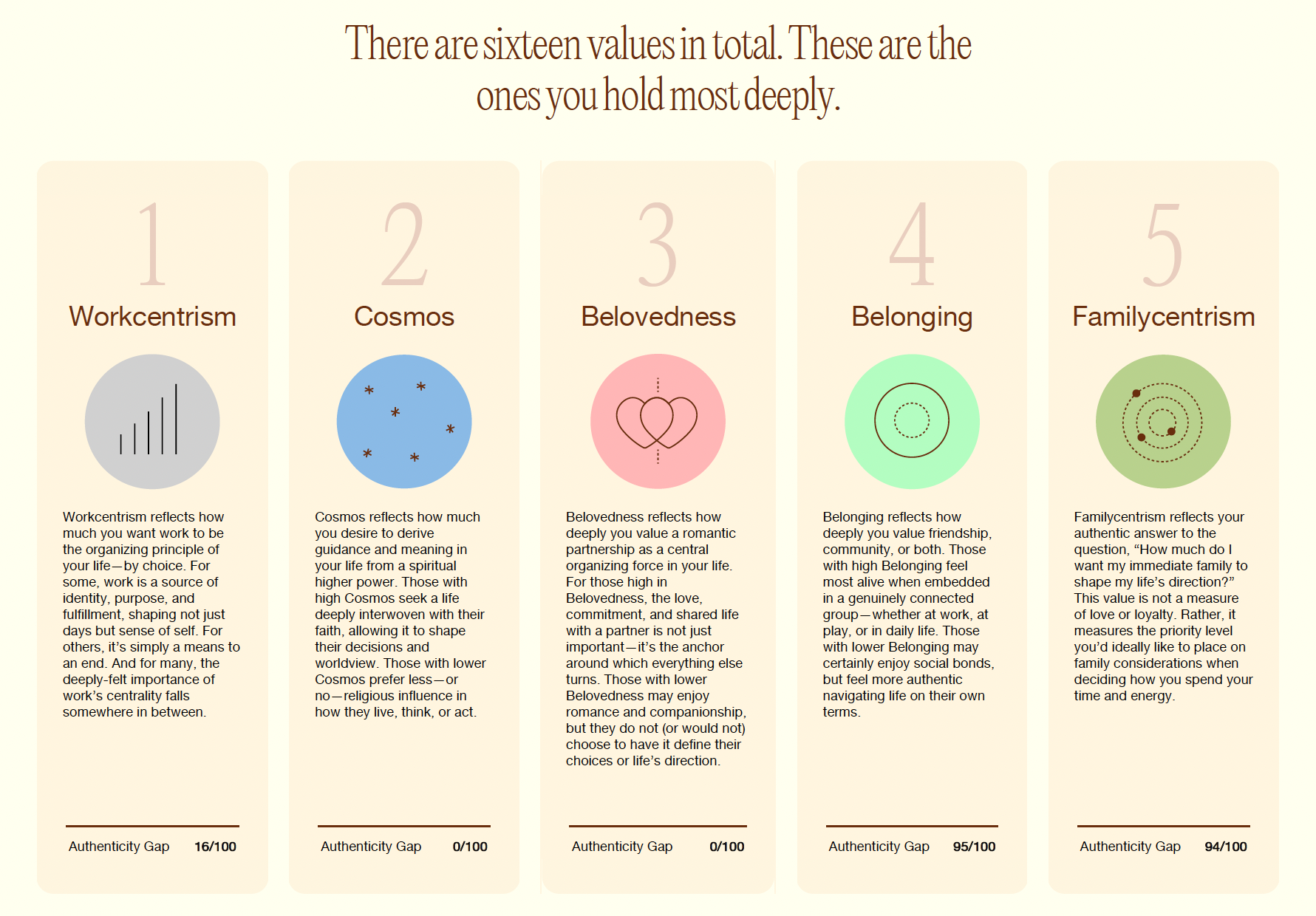
My top 5 results
Reviewing these results inspired a great deal of thought about which core values were already manifest and bringing me joy, and which might be dormant in my life due to fear, sloth, or even disillusionment. With some pain I noted how the ones with higher dissonance between desire and action reflected the very topics that depression had made me feel insecure about.
And I realized that, if I wanted to live an emotionally resonant life, recover from a season of wintering and start to feel inspired again, I ought to get a move on applying these organizing principles to my every day life. And so:
I started writing again.
I started praying.
I joined a yoga studio.
I started quietly leaning into greater vulnerability with loved ones, ignoring the echoes of the inner critic and trusting that this was the path to greater sense of belonging, no matter how anxious I felt.
Overall, it’s been a rewarding time of single-mindedly pursuing neglected priorities that used to generate profound joy. I can feel the more consistent value-based action fortifying my self-confidence, soothing lingering unease from latest mood episodes, and even releasing me to embrace times of rest with less sense of guilt.
Creative Expression of Values & Feeling More Seen
I think the true beauty lies in the endless configurations of ways we can creatively apply our core values. For example if we value Workcentrism, perhaps we might push harder to find forms of work that align with our unique passions and hobbies. If we long to have a Voice, maybe there are creative platforms and ways to share our opinions on an endless number of topics. If we value Radius, we could start to make a practice of noticing even the smallest ways throughout the day that our behaviors can positively influence others.
And those around us will sense the renewal, by reflexively mirroring our progress back to us through their language and interactions. When we act on our values, we start to see ourselves more and more clearly as people living a life of integrity. The feedback of others then further drives home the message that this is who you are, and who you are is deeply good.
Over time, this synergistic process can undo layers of mental and emotional wounds and even deepen our relationships.
I’m so thankful for the powerful reminder from values work that it’s not what we feel or think that defines us, but rather what we do with what we have been given.
Those of us with mood disorders have been dealt a hard deck of cards. And while we might not ever be able to make the voice of self-doubt go completely away, we can find clarity and strength in acting out our values each day, trusting in the process and, taking one step at a time.
Thank you for reading, and if you want to explore your own values work, here are some helpful resources that can be a good starting place:
