How to Harness Your Dreams: A 4-Step Guide to Jungian Dreamwork
“The dream is the small hidden door in the deepest and most intimate sanctum of the soul, which opens to that primeval cosmic night that was soul long before there was conscious ego and will be soul far beyond what a conscious ego could ever reach.” - Carl Jung, 1934

Recently I finished psychoanalyst Robert Johnson’s 1986 book Inner Work: Using Dreams and Active Imagination for Personal Growth, and found it incredibly useful in my foray into dream work. Here, I’ll draw from his elegant teaching on Jungian theories on the Self, and describe his straightforward 4-step approach for analyzing your own dreams.
Dreamwork is one of many activities Jung believed can be used for catalyzing personal growth. It stands alongside active imagination, creative expression, shadow work, spiritual experiences, and interpersonal feedback (e.g. learning from our projections onto others) as an entryway to greater self understanding and clarity in our decisions.
According to Jungian psychology, individuation is our greatest life task, the lifelong process of becoming the whole unique persons we were born to be. In this effort, we are to be forever in progress, attuning to our core values (or organizing principles) and building trust with ourselves through daily embodiment of those convictions.
You can tell that you are growing stronger when there is a sense of inner security, confidence in choice making, and more self assuredness. Instead of only living out of your ego-mind or conscious thought with its complexes and defense mechanisms, you greater embody your full Self with its light and dark, impulses or longings in harmony.
Key Psychoanalytic Concepts
Our unconscious is more than repressed memory. It is the depths of our psyche and serves to complement our conscious ways of thinking and acting. It is similar to an untapped field of energy, the deepest and darkest part of an iceberg, or a vast unseen ocean filled with wisdom, strength, and intuitive intelligence. All are qualities that inform our true selfhood, spirit, and even our soul formation.
Jung described the unconscious as generative and generous; it respects our ego-mind’s choices (aka waking thought) while also holding us accountable to learning from the consequences of those choices.
In his work with patients, Carl Jung came to see what he called neuroses (e.g. excessive worry, obsessive thoughts, and existential anxiety) as consequences of rifts between our unconscious and our conscious mind. He also identified complexes as emotionally charged parts of us that hold overwhelming attachment memories, and can control of our behavior (an inferiority complex, “daddy issues”, a “momma’s boy” or mother complex, etc.).
All parts of our psyche are designed to live in harmonious relationship, and division is akin to an intrapsychic wound. Division can manifest as repressing or neglecting parts of yourself or your lived experiences, acts of self sabotage, chronic tension, and a vague sense of confusion about who you are.
Dream analysis serves as one opportunity to heal these rifts and move toward greater psychic integration.
Tapping Into Universal Drives
Dream work involves becoming acquainted with archetypal energies within and around us. Our psyches, comprised of all unconscious and conscious elements, are said to contain unique combinations of universal and personal archetypes. Universal patterns are a result of being part of what Jung called the collective unconscious, the layers of each person’s psyche that are shared by all humanity.
The collective unconscious is a shared reservoir carrying the blueprint for all aspects of human psychological experience. This blueprint contains infinite patterns such as primordial drives, symbols used across cultures, and the traits or qualities we each embody to various degrees (shaped by personality and life experience).
When we come across archetypal symbols in dreams, we often feel familiar with them on an intuitive level. Some examples are the instinctive energy of The Self, The Anima or Animus, and The Shadow. These three are key parts to individuation.
Other archetypes such as The Mother, The Lover, The Warrior, The Seeker, or The Sage are easily observable as they powerfully influence our relationships and priorities in waking life. In considering these symbols, we might feel awe at their potency and purity of human expression, or even sense them as impersonal forces embedded in our nature and shaping our deepest impulses.
Our psyches also possess unique expressions of universal patterns. These are shaped by personal experience, temperament, and traumas which can leave psychic wounds.
The 4 Steps of Dreamwork

“In the world of the psyche, it is your work, rather than your theoretical ideas, that builds consciousness. If we go to our own dreams and sincerely work with the symbols we find there, we generally learn most of what we need to know about ourselves and the meaning of our lives.” - Robert Johnson
Drawing from his clinical work in the 1950s, Johnson designed a 4-step guide for people to do dream work without the aid of traditional psychoanalysis. He noted that dreams provide feedback on our individuation progress or can serve as time stamps marking stages of our journey.
We can learn to draw insights and even lessons from them to apply in daily life and relationships.
Step 1: Write Down Your Associations from The Dream
Start by reviewing your dream content as if watching a movie, scanning the scenes from start to finish or as much as you remember. Quickly write down whatever words come to mind. It’s helpful to do this immediately after waking or soon after.
Write down a word or phrase that describes each notable part (e.g. huge blue sky, standing at playground, kids around playing, parents walked over, feeling of sadness).
Beginning with the first notable image, jot down any associations or feelings that come to you (e.g. for standing at playground: childhood, inner child, nostalgia, trust and innocence). Draw from concepts or feelings that well up as you reflect.
Don’t use chains of associations that take you further and further away from the image (this is what Freud practiced with his patients, and where he and his colleague Jung diverged); instead, stick to direct associations as Johnson illustrates here:
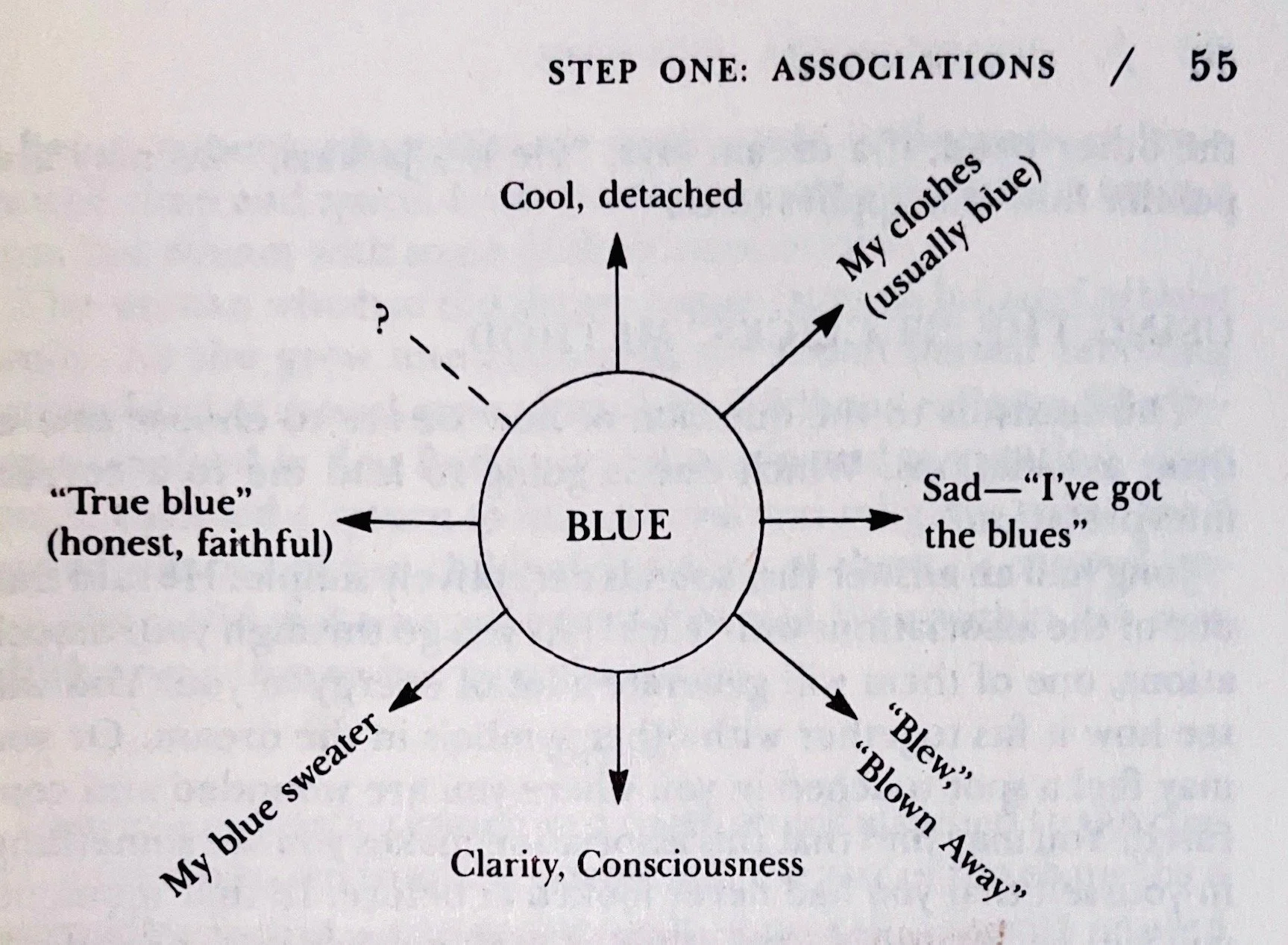
Next, scan the associations and notice which ones click with you energetically, stirring a sense of conviction inside you. Make special note of these. You can free write about these as much or as little as you need. This is where knowledge of archetypal symbols becomes useful.
Looking for universal archetypes: Ask yourself, Does my dream have a mythical quality? Does it feel almost like a fairy tale or something otherworldly? Identify and write down any archetypes you recognize. We’ll explore in Step 2 what they have to say about who you are, or what energy is at work inside you.
Looking for personal associations: Do the images remind me of details from my personal life? Do I recognize any symbols?
Johnson cautions us from looking up meanings for dream symbols because they are not a one-size-fits-all. There are certainly common motifs (e.g. of falling, flying, teeth falling out, or snakes), but they always contain messages unique to your unconscious activity.
Step 2: Reflect on What The Associations Say About Your Inner Life
Here we dive deeper into the meaning of associations that clicked with you, and any themes, people, places, animals, symbolic shapes, colors, numbers etc., that are present.
On People
If there are people in the dream that you recognize: Remember that our unconscious typically portrays themes of our inner world, and is not focused on commenting on others.
Johnson explains that “people often get confused over this issue, because the unconscious has a habit of borrowing images from the external situation and using those images to symbolize something that is going on inside the dreamer”.
Ask yourself, Are there any notable traits to this figure? Does part of me resonate with or feel repelled by that trait? What does this say anything about my personal qualities, current beliefs, attitudes, or core values?
For example if you dream of an argument with your sister, it may speak to traits of hers that are in your shadow (e.g. if you feel frustrated with her aloofness, you might be repressing qualities of independence or healthy detachment, and might even be having difficulty maintaining boundaries in your own relationships).
If you dream of a stranger or someone with a social function: (e.g. police officer or janitor) you can ask, What are their traits and duties? What are they doing in my dream? Explore what function they may be alluding to in your inner world.
Two common figures that appear in dreams are the shadow and the soul image. Both are archetypes closely tied to the energy of The Self.
The shadow is like an alter ego which has been rejected by our conscious ego-mind and dwells in our unconscious. It possesses qualities we have repressed, perhaps out of a desire for self-preservation in our highly judgmental world.
The soul image is a psychopomp who mediates between your conscious and unconscious parts and guides your quest to integrate your Self. Jung believed there to be a feminine soul image called the anima, and a masculine soul image of the animus.
For more understanding of the anima and animus, we must note that our psyche is androgynous in that it contains both masculine and feminine energies as complimentary psychic principles. Unlike modern day pop psychology caricatures, Jung viewed these as universal polarities that live in dynamic harmony (much like the Eastern concept of yin and yang).
We can learn to dance between these inborn features of our psyche and the powerful qualities of each: feminine intuition, poetry, and emotion, and masculine logos, word, and structure. They are not to be performative but rather inner capacities that we each express in unique variations.
If you see a dream figure you believe to be your soul image, it may be inviting you to deeper integration or to greater expression of some dormant quality lying within you.
On Places
For a dream image of an actual place you might ask yourself, Who does this place belong to? For example, if you dream of visiting your grandmother’s house, you may be attuning to The Mother energy.
But if you dream of lying sprawled in the gutter outside her house, you might be in the midst of an unconscious struggle with your own mother complex.
On Animals
We often associate animals such as dogs with loyalty, pack mentality, humble nature, or primal instincts. These might be speaking to your character qualities or growth needs in negative or positive ways.
Snakes are an ancient symbol of creation and destruction and can represent renewal (shedding an old skin), danger (from too much suppressed feeling), and even transformation (a sense of awakening). Ask yourself, What feeling does this animal evoke in me? Where was it, and what was it doing in the dream sequence?
On Colors
Colors also carry positive and negative connotations (e.g. green for nature and life force, and also envy). For the color blue and a corresponding association of depression you might consider, Where is that blue quality in me? Where am I blue? Where have I been depressed?
Write down any specific examples you find in your life.
On numbers
Numbers have great symbolic significance and they traditionally suggest order and structure. We can look to cultural meaning (1 as unity, 2 as duality, 7 as creative completion, 12 meaning cosmic order, etc.). But again, personal associations within the context of the dream are to be prioritized first. It is the specific details of the dream context that reveal the most accurate interpretation.
Step 3: Interpret The Meaning or Main Insight of The Dream
Interpretations answer the question: What is the central, most important message this dream is trying to tell me? What might it be advising me to do? What is the overall meaning of it for my life?
Write down the single most important insight you feel your unconscious is communicating. It can take some time to come to a coherent, clear theory that summarizes your impressions in a nutshell.
If you think of multiple interpretations, write them all out. Again, the most accurate insight should click and generate strong feeling in you. Johnson strongly encourages the act of writing as “it brings it off the level of fantasy and abstraction and gets it into a form that you can see clearly. With the act of writing, you begin to get a better feeling about whether it really makes sense to you or not.”
There are 4 guiding principles for verifying your theory:
It should challenge your assumptions and teach you something
It should not only serve to inflate your ego like a smug pat on the back, as this only reinforces assumptions or blind spots
It should place focus and responsibility for growth on you, and not outsource blame to others
It could take time for the meaning to clearly show up in your life (e.g. it is commenting on your growth across time rather than on a current situation)
Step 4: Create a Physical Ritual to Apply Your Insight
Now we can use our imagination to plan a symbolic act to perform in real life that affirms the dream’s message. This small, physical act helps to embody the lesson and integrate it within our psyche.
Ask yourself, What can I do about the dream, in honor of the message?
This could look like carving out time for something or someone you have neglected, burying an object that represents a negative energy or trait, or even releasing something symbolically in the ocean. It can also mean lighting a candle or going for a meditative walk.
Rituals are historically symbolic behaviors that reinforce psychological or metaphysical experiences in concrete reality. Johnson argues that they are a critical part of fully processing your dream content.
Small and subtle rituals are often the most effective, as they are quietly representing a commitment to adopt an inner attitude change.
It’s best to act on the ritual within a few days after doing your dreamwork.
If you feel a dream is telling you to confront or make amends with someone, completing the 4 Steps can help you to navigate those conversations in a more constructive and emotionally grounded way.
A Personal Illustration
So far I have followed the 4 Steps myself to analyze three dreams — a nightmare, mythical tale, and a personal fairytale.
Here is a summary of the mythical dream I had in July and how it later took shape in my life:
I dreamt that a strong, wise old man was in a stone chamber wrestling for a lengthy time with an evil being that needed to be subdued. The old man was slowly winning and wearing down the energy of the evil being pinned down on a stone slab and struggling to escape.
A foolish character that looked like John Cena was standing outside the chamber door knocking and calling to go in. Impatiently he opened the door and saw the shocking scene, and with a cry of alarm rushed over to help. He did not stop to understand the nuance of what he saw.
The old man shouted for him to stay back! and not interrupt as he would throw off focus and disrupt all the hard-won effort to win, giving evil a chance to escape. I awoke shaken and very angry at Cena.
Later I journaled about my reflections:
I think the two figures are parts of my subconscious, specifically the archetypes of The Wise Old Man and The Eternal Youth. Part of me is being foolish and impatient and part of me has been doing incredible yet slow work that must not be interrupted. It seems that victory is almost near.
I see this as a cautionary dream telling me to wait and not allow the Youth inside me to barge in and sabotage things. It seems like it might be a wrestling toward something in my future? Or maybe struggling with old nervous system imbalance or trauma ruminations thwarting growth? I think I need to contain my impulsive, impatient parts that don’t understand nuance very well.
It is now November and there have been a few situations since the dream where I acted impulsively, either from hubris or strong winds of emotion. Thankfully none of these choices have caused permanent ruptures, and I attribute this in part to remembering the dream and to practicing patience. I have also experienced some healing in several key emotional areas, which might be the victory that the dream spoke about.
Thank you for your interest and excitement about mining your own dreams for guidance and personal growth.
I invite you to check out Johnson’s writing for yourself, along with these thought-provoking resources:
